
For the next two weeks my evenings and weekends will be occupied with one thing... of course that will be changing diapers... or maybe keeping an eye on our toddler, but in between I'll be keeping up with America's progress at the 2006 Winter Olympic games.
2.08.2006
Less than two days and counting - Torino 2006

2.07.2006
Best financial advice
Monday night in Community Group we were asked to share advice we'd give to a newly engaged and a newlywed couple. One piece of advice I'd offer is fortunately one I learned early in my marriage.
I've since figured out that people who teach real estate investment classes and sell tapes, CDs, and books about real estate investing normally make more money teaching about real estate investing than they actually do investing in real estate. Years ago my wife and I attended a real estate investment class from John Adams here in Atlanta where we learned very little about the topic at hand but took away some completely unexpected wisdom. Mr. Adams offered the following advice that we apply to this day: finance things that appreciate and pay cash for things that depreciate.
In practice, this means financing your home since it is an appreciating asset. For most Americans, that's not a problem--I don't know of anyone sitting on a big pile of cash who is considering using this cash to buy a home. The second part of Mr. Adams' sage advice, however, means saving enough money to purchase a new or used vehicle rather than financing it. I had done this most of my life, but then again, I drove a crappy 1988 Volkswagen Fox station wagon when I met my wife. I remember the time my wife and I purchased our first vehicle together. We decided to apply this principle, so we saved. I never thought I'd be able to pay cash for a nice car, but we started with an older vehicle and bought a used Ford Explorer with cash. Through the years we've continued to upgrade to newer and newer vehicles as we've saved more and more until last year when we were finally able to buy a new car (minivan, actually).
Why does this principle make so much sense? The answer has to do with the "cost" of money. If you're financing a $30,000 vehicle over 5 years at 5% which depreciates 20% a year, your real cost of the vehicle is actually $7,500 for the first year. Here is the calculation: $1,500 interest ($30k cost x 5% simple interest) + $6,000 in depreciation ($30,000 cost x 20% depreciation per year) on the vehicle. In paying cash for the vehicle, your real cost is only the $6,000 depreciation on the vehicle, which is 21% less than the cost had you financed it.
But Dorkydad, I want a brand new BMW 650i convertible! Tough--so do I, but at $78,800, the only way I'm going to get one is by starting to save now. If you want to do this (pay cash for things that depreciate), make some sacrifices with your first vehicle. Maybe it's not the newest, maybe it has a standard transmission, maybe it has 100,000 miles, and maybe it's not the color you had in mind, but trust me--the peace of mind in not having a car payment as well as the extra cash you'll have each month will more than make up for any buyer's remorse.
I've also discovered that this advice marries up well with some biblical wisdom. Proverbs 22:7
establishes that borrowers become slaves/servants to a lender, so I see Paul's statement, "You were bought at a price; do not become slaves of men" found in 1 Corinthians 7:23 as encouraging us to stay out of debt.
World's Smallest Political Quiz
In a recent post I mentioned that I'm technically a libertarian, and earlyadopter asked me what I meant by the term "libertarian". There is actually a Libertarian Party in the U.S., and I like their definition:Libertarians believe the answer to America's political problems is the same commitment to freedom that earned America its greatness: a free-market economy and the abundance and prosperity it brings; a dedication to civil liberties and personal freedom that marks this country above all others; and a foreign policy of non-intervention, peace, and free trade as prescribed by America's founders.
To see where you fall politically, take the world's smallest political quiz... you might be surprised! And when you take it, please share your score. Here are my results:
2.06.2006
Bad officiating robs Seahawks of the Lombardi Trophy
I'm a Falcons fan so some may perceive me as having an NFC bias, but I really was completely indifferent as to who would win Super Bowl XL though I would have liked to see a fair game. Instead, given its importance, it was the worst-officiated game I've ever seen in my life.
Seattle had two touchdowns negated by bad calls from the officials. I didn't expect any critical analysis from the wonder-twins, Al Michaels and John Madden, but they made several comments about the bad calls throughout the game. And then Steve Young at halftime said, "That was a touchdown," of the Darrell Jackson pass interference call. The traditional press' response was slow, but Michael Smith from ESPN.com and the Kansas City Star's Jason Whitlock addressed the officiating problems. Kudos go to The Miami Herald for carrying Whitlock's story. As a followup, I've since found these other stories related to the poor officiating:
- Michael Wilbon from The Washington Post
- Los Angeles Times had problems with the zebras
- Houston Chronicle
- Another story from The Washington Post
- San Jose Mercury News
- USA Today
- Sports Illustrated
- CBS Sportsline
- and another one from USA Today
- Chicago Sports Review
- The Arizona Republic
- Redskins' blog
- Courier News
- Seattle Post-Intelligencer
- Fox Sports
- and Fox Sports again
2.03.2006
54th Annual National Prayer Breakfast
Established in 1953, the National Prayer Breakfast is an annual event organized by The Fellowship Foundation. This year's event was held yesterday at the Hilton Washington Hotel with around 3,000 attendees, including U.S. government officials as well as dignitaries from several nations.
Aside from President Bush, this year's speakers included King Abdullah II of Jordan and Bono from U2. Bono's words are worth a read [click here]. Credit goes to Sojomail for alerting me to this. And the "Jim" referenced in Bono's speech is Jim Wallis, author of God's Politics and Editor-in-Chief of Sojourners.
Actions speak louder than words
I was working at my project house on Tuesday night and had trouble finding the president's State of the Union speech on the radio. By the time I found it on NPR, I missed the first 10 minutes but did get to hear the Democratic response in its entirety. I'm not sure who selected Virginia Governor Tim Kaine as the speaker for the Democratic response, but if Kaine was the best choice for Democrats then their party is in serious trouble. I'll comment later about Kaine's "better way".
I found the text of Bush's speech on the White House website to read what I missed. I don't want my daughters' generation to inherit a nation drowning in government debt, so I was keen to know what he had to say about spending. I found these words interesting:
Keeping America competitive requires us to be good stewards of tax dollars. Every year of my presidency, we've reduced the growth of non-security discretionary spending, and last year you passed bills that cut this spending. This year my budget will cut it again, and reduce or eliminate more than 140 programs that are performing poorly or not fulfilling essential priorities. By passing these reforms, we will save the American taxpayer another $14 billion next year, and stay on track to cut the deficit in half by 2009.What exactly is "non-security discretionary spending" (hereinafter referred to as NSD)? NSD is all discretionary government spending minus expenses related to defense, international and domestic (homeland) security. It represents just under 16% of the federal budget, and by the way--it's the only part of the budget that isn't growing rapidly (ballooning is the word used by the Wall Street Journal). Yes, even the traditionally conservative Wall Street Journal wrote an article critical of the expanding Bush budget. Bloomberg has an interesting article related to this subject as well.
Overall federal spending is up 42% under Bush according to numbers from the non-partisan Congressional Budget Office (CBO). Rising interest payments on the growing national debt as well as rising interest rates both contribute to the increased federal spending since interest on the national debt accounts for 8% of federal expenditures. Bush's new prescription drug benefit plan increases the cost of Medicare, so this too contributes to the problem. The CBO projects interest costs will increase 18 % in the current fiscal year, and Medicare will rise 17%. One thing to note is that neither interest on the debt nor Medicare expenses are mandatory expenditures and therefore don't fall into "non-security discretionary spending".
Bush indicates that "these reforms... will save the American taxpayer another $14 billion next year, and stay on track to cut the deficit in half by 2009." While $14 billion is a start, it's only 0.5% of projected federal spending in 2006. What Bush omits from his statement is that the entire federal deficit is projected to rise 6.3% this year from $317 billion last year to $337 billion this. These CBO numbers don't take into account the $138 billion Bush will ask Congress to approve for military operations in Iraq and Afghanistan as well as hurricane relief. If Congress approves this request, the deficit will rise at least 26% this year from $317 billion to over $400 billion. Yikes!
I truly hope President Bush, the Republican-controlled Congress, and the Republican-controlled Senate are as serious about fiscal discipline as they claim, but so far their actions speak louder than words.
2.02.2006
Rental properties and water damage
I'm taking a couple of weeks of paternity leave, and with family in town to help watch our toddler I decided to try and get some work done on my project house that's in the middle of a renovation on its way to becoming rental property. I enjoy doing much of the work myself because unlike my 9 to 5 job, it allows me to work with my hands and gives me the opportunity to physically see the transformation of a project.
I've found that many people are under the impression that managing rental properties has more to do with depositing rent checks than anything else. While that's certainly the goal, there's a lot of preparation that goes into making a rental property low maintenance. And it starts with doing all of the necessary improvements up front. I take the approach of actually over-improving rental properties, but I'll explain why in a future blog.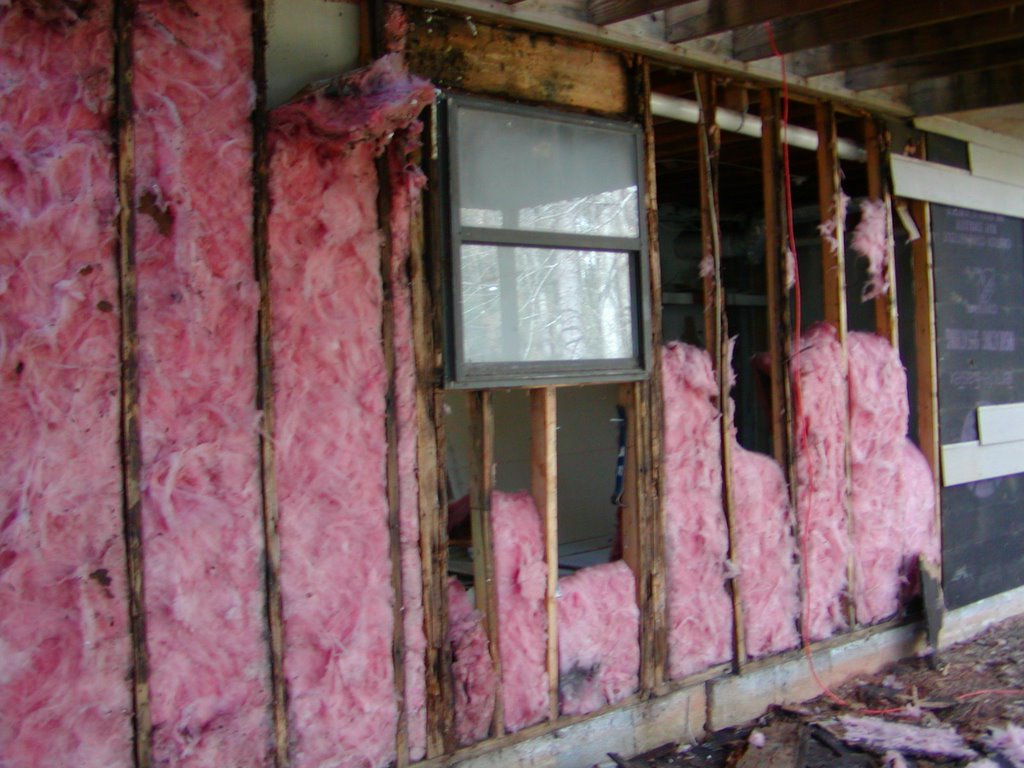 On Tuesday I planned to tear down some warped pressed wood siding which had water damage and replace it with Hardiplank cementboard siding. It should have been a one-day job, but as often happens, the project became a lot more involved. As I removed the damaged siding, I realized the Celotex fiberboard sheathing was disintegrating which led me to see that the 2"x4" studs holding up this load-bearing wall had rotted 75% of the way through. Water is the #1 source of deterioration on a house because not only can it cause damage, but it attracts insects like termites & carpenter ants while also creating an environment for mold & mildew to grow.
And I was really hoping to get the exterior of the house ready for painting this week, but that was not to be.
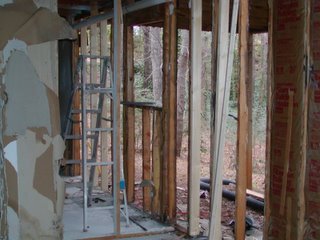 I spent Tuesday removing the siding from the back of the house as well as any fiberboard sheathing that didn't flake off with the siding. I also made a run to Home Depot to pick up new 2"x4"s, sheathing, plastic to be used as a water barrier between the studs and sheathing, felt paper to be applied over the sheathing, and a few other things on my list. How I wish there was a Lowe's in East Cobb to give Home Depot some competition. Making a "run" to Home Depot is as close to hell as I ever want to get. The problem on this trip was their signage--they had two different prices posted for an item on my list. Both signs had the same sku/UPC, and of course the higher price is what came up on the cash register. The difference wasn't much, but given their awful service (I couldn't find a single salesperson on the floor to help) and poor inventory management (two items I needed were either sold out or hadn't been re-stocked) I challenged them on the price. I walked the disbelieving cashier to see the sign, and then she had to call a manager to show him. So a half hour later I was finally out the door, thankful I dumped my HD stock last year.
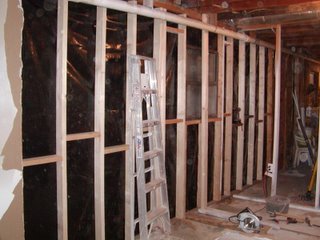 Wednesday I needed to replace the studs, so I started off by supporting the top plate while each rotted stud was removed one by one, and replaced with new 2"x4"s. For added strength, I also put a 2"x4" brace between each stud. I then reinstalled the window and nailed down the black plastic over the studs. Tomorrow the new sheathing will go up as well as the new siding. Rain is in the forecast, though, so I could be completely screwed.
2.01.2006
My browser can beat up your browser
If you use the Internet frequently and are still using Internet Explorer (IE) as your browser, you're missing out while making your PC more vulnerable to malicious software. As of late October of last year, though, 81% of Americans used IE while only 14% used Firefox.
Nearly a year ago I had my IE browser hijacked, and despite attempts to regain control of IE via Microsoft's Malicious Software Removal Tool I was never able to completely eliminate the malicious code. How was it hijacked? I have no idea. It was my work PC which has a pop-up blocker as well as an anti-virus tool running all of the time. I'm not technologically illiterate, but I'm dumbfounded by how this happened.
It was then I began reading up on how to better protect my system while browsing and learned about the major security gaps in IE. I then read about two new browsers: Opera and Firefox. I tried them both, and after a month switched permanently to Firefox. It has many great features, but the one I like most is tabbed browsing. I also like the fact that its plug-ins can be added & removed easily. My favorite so far is Flashblock.
Subscribe to:
Comment Feed (RSS)


